Capuchin
friar
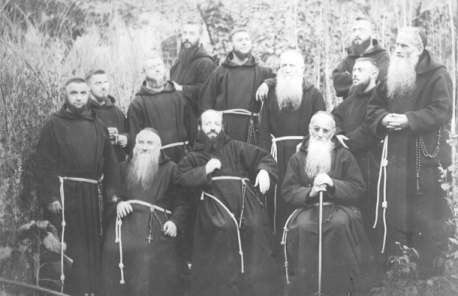
F. Arsenio decided to become Capuchin
when he was 53, perhaps on advice of the blessed Andrea Carlo Ferrari,
after having spent some days of spiritual exercises in the convent of Velasquez
Square in Milan. On 21st June 1902 he was clothed in Lovere and started
his noviciate. At that time the probationary year was very strict with
punishments of every kind that no one was spared. And he wondered: “Oh
Arsenio, try to understand the great mystery that you are, you ask God
for the holy humility and then you refuse any kind of humiliations. How
odd and unreasonable you are! You would like the aim and not the means!
The means by which you can achieve humility are humiliations and it is
only through the repetition of these that then you can form the clothes,
the virtue of humility and of all other moral virtues. It is like making
clothes: you need the material and the stiches; the material can be the
will or also the isolated virtue, the stiches fix it on your body”
(P 391/26/33 p. 12). Arsenio
had always been coherent in his life, in fact he had already used the image
of the clothes, as he was a Jesuit.
 He had become Capuchin because he had
chosen it, it hadn’t been a makeshift-decision. While he was preparing
himself for the temporary profession, which took place on 25th June 1903
(the perpetual one on 25th June 1906), during the spiritual exercises,
he was writing: “Now, think about yourself. Are you prepared to all
this? Think that poverty is the main badge of the religion you are going
to embrace. The seraphic poverty is very high, absolute poverty without
any exceptions. The smallest thing is enough to contaminate it. If you
observe it and keep the holy Poverty conscientiously and carefully, you
will always be a good Capuchin, but if you don’t, your ruin will be already
marked. Heaven help the Capuchin who doesn’t observe poverty!” (P
391/21, 8v).
He had become Capuchin because he had
chosen it, it hadn’t been a makeshift-decision. While he was preparing
himself for the temporary profession, which took place on 25th June 1903
(the perpetual one on 25th June 1906), during the spiritual exercises,
he was writing: “Now, think about yourself. Are you prepared to all
this? Think that poverty is the main badge of the religion you are going
to embrace. The seraphic poverty is very high, absolute poverty without
any exceptions. The smallest thing is enough to contaminate it. If you
observe it and keep the holy Poverty conscientiously and carefully, you
will always be a good Capuchin, but if you don’t, your ruin will be already
marked. Heaven help the Capuchin who doesn’t observe poverty!” (P
391/21, 8v). After the simple profession he was
moved to Bergamo’s convent and he devoted himself completely to apostolate:
preaching, confessions and assistance To the Franciscan Secular Order as
to be defined “ a real apostle of the Franciscan Third Order
(Franciscan Annals 40- 1909- p. 210)
as it was called at that time.
He went on preaching the importance
of spiritual exercises but his preaching had assumed some particular features,
as he wrote in 1903.: “ Teaching and preaching things that may be
practised and not just theoretical or admirable ones.” (P
392/26/33 p. 66).
About the exercises held in Brescia
in June 1903 intended for Tertiaries has been written: “This year
they were held by the Reverend Father Capuchin Arsenio da Trigolo. In an
easy and simple way,with words springing spontaneously from the heart and
reaching the heart, he reminded the tertiaries of eternal truths, he informed
them about their duties as Christians and daughters of St. Francis”
(Franciscan Annals 38 -1907- p. 447).
The spiritual exercises would be remembered
the following year when it was written that the tertiaries “after
listening to the preaching felt even happier to belong to an Order which
was so rich in spiritual values and were encouraged to observe the Rule
and to attend to their sanctification” (Franciscan
Annals 39-1908-p. 89).
Father Arsenio himself, writing to
sister Maddalena, said: “In these days I have held exercises for
prisoners in Bergamo, most of them are young women between 23 and 35, 40
years of age, some have already been found guilty.: the prison manager
doubted all this could do them good, yet God’s grace worked so well, and
they all answered our expectations in a surprising way. God helps those
who really serve Him well” (Lessi-Ariosto,
p. 92).
After the simple profession he was
moved to Bergamo’s convent and he devoted himself completely to apostolate:
preaching, confessions and assistance To the Franciscan Secular Order as
to be defined “ a real apostle of the Franciscan Third Order
(Franciscan Annals 40- 1909- p. 210)
as it was called at that time.
He went on preaching the importance
of spiritual exercises but his preaching had assumed some particular features,
as he wrote in 1903.: “ Teaching and preaching things that may be
practised and not just theoretical or admirable ones.” (P
392/26/33 p. 66).
About the exercises held in Brescia
in June 1903 intended for Tertiaries has been written: “This year
they were held by the Reverend Father Capuchin Arsenio da Trigolo. In an
easy and simple way,with words springing spontaneously from the heart and
reaching the heart, he reminded the tertiaries of eternal truths, he informed
them about their duties as Christians and daughters of St. Francis”
(Franciscan Annals 38 -1907- p. 447).
The spiritual exercises would be remembered
the following year when it was written that the tertiaries “after
listening to the preaching felt even happier to belong to an Order which
was so rich in spiritual values and were encouraged to observe the Rule
and to attend to their sanctification” (Franciscan
Annals 39-1908-p. 89).
Father Arsenio himself, writing to
sister Maddalena, said: “In these days I have held exercises for
prisoners in Bergamo, most of them are young women between 23 and 35, 40
years of age, some have already been found guilty.: the prison manager
doubted all this could do them good, yet God’s grace worked so well, and
they all answered our expectations in a surprising way. God helps those
who really serve Him well” (Lessi-Ariosto,
p. 92).
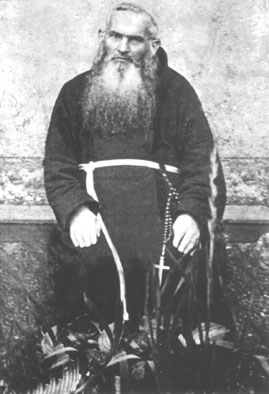 There were so many confessions that
he wrote in a letter: “Now I must finish because there are so many
people who want to confess themselves” (Ivi,
92).
Father Arsenio never had an iron constitution,
but towards the end of his life some troubles became more persistent. In
1908 he was writing as usual to sister Maddalena: “I have had my
illnesses too: I had three hemorrhages. For three months, yet not from
the lungs but from the break of a small vein, due to exertion: preaching,
confessing…” (Ivi, p. 90).
But in the last letter written to the same nun on November 19th 1909, he
added: “I have had this letter written by one of my Brothers, who
acts as a secretary, because I have had an eye paralaysed for one month,
I am undergoing some treatment and God’s will be done” (Ivi,
p 91). This shows us the Christian spirit he faced
physical pain with.
On December 10th he was found dead
in his cell, struck by aneurism. The sudden death did not find him unprepared.
In 1886 he had written: “Do you want to die a holy death? Well, live
a holy life according to your religious status. Be holy in your looks,
in your speeches, in your hearing, in your features, in your taste, in
your touch, in short, be perfect in using your senses. Be holy in obedience,
be holy in the fulfilment of your duties and vows and then you will die
a saint.Since if you don’t live a saint life and you hope to die a saint
it is a real paradox, an absurdity, it is like wishing the aim without
the means” (P 391/18 p. 27-28).
The day following his death, the Bishop
of Bergamo, mons. Giacomo Radini Tedeschi, wrote to the Superior of the
Capuchins: “Father Arsenio, about whose sudden death I was informed
yesterday,has done good to my Diocese, to the extent that I can’t abstain
from expressing to this Community, my deepest regret, which I kindly ask
you to communicate to your worthy Brothers. Please let me know the day
of the funeral, as I want someone to represent me”.
There were so many confessions that
he wrote in a letter: “Now I must finish because there are so many
people who want to confess themselves” (Ivi,
92).
Father Arsenio never had an iron constitution,
but towards the end of his life some troubles became more persistent. In
1908 he was writing as usual to sister Maddalena: “I have had my
illnesses too: I had three hemorrhages. For three months, yet not from
the lungs but from the break of a small vein, due to exertion: preaching,
confessing…” (Ivi, p. 90).
But in the last letter written to the same nun on November 19th 1909, he
added: “I have had this letter written by one of my Brothers, who
acts as a secretary, because I have had an eye paralaysed for one month,
I am undergoing some treatment and God’s will be done” (Ivi,
p 91). This shows us the Christian spirit he faced
physical pain with.
On December 10th he was found dead
in his cell, struck by aneurism. The sudden death did not find him unprepared.
In 1886 he had written: “Do you want to die a holy death? Well, live
a holy life according to your religious status. Be holy in your looks,
in your speeches, in your hearing, in your features, in your taste, in
your touch, in short, be perfect in using your senses. Be holy in obedience,
be holy in the fulfilment of your duties and vows and then you will die
a saint.Since if you don’t live a saint life and you hope to die a saint
it is a real paradox, an absurdity, it is like wishing the aim without
the means” (P 391/18 p. 27-28).
The day following his death, the Bishop
of Bergamo, mons. Giacomo Radini Tedeschi, wrote to the Superior of the
Capuchins: “Father Arsenio, about whose sudden death I was informed
yesterday,has done good to my Diocese, to the extent that I can’t abstain
from expressing to this Community, my deepest regret, which I kindly ask
you to communicate to your worthy Brothers. Please let me know the day
of the funeral, as I want someone to represent me”.
Father Arsenio was buried in the
cemetery in Bergamo.
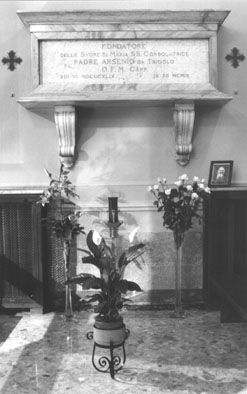 In
1940 his mortal remains were taken to Cepino Imagna and in 1953 they were
transferred to the chapel in the mother house in Via Melchiorre Gioia in
Milan.
His memory has never faded, but
just a little weakened. His nuns, returning to the sources of their own
spirituality according to the strong call of the Vatican Council II, have
rediscovered their founder and the wealth of his teaching. Once again God
wants to draw the attention on his stone. He wants the Church to recognize
his spiritual experience as a model to reach eternal bliss. This will be
to the advantage of the nuns and his Capuchin Brothers, but will also do
good to all those who know and approach him.
In
1940 his mortal remains were taken to Cepino Imagna and in 1953 they were
transferred to the chapel in the mother house in Via Melchiorre Gioia in
Milan.
His memory has never faded, but
just a little weakened. His nuns, returning to the sources of their own
spirituality according to the strong call of the Vatican Council II, have
rediscovered their founder and the wealth of his teaching. Once again God
wants to draw the attention on his stone. He wants the Church to recognize
his spiritual experience as a model to reach eternal bliss. This will be
to the advantage of the nuns and his Capuchin Brothers, but will also do
good to all those who know and approach him.